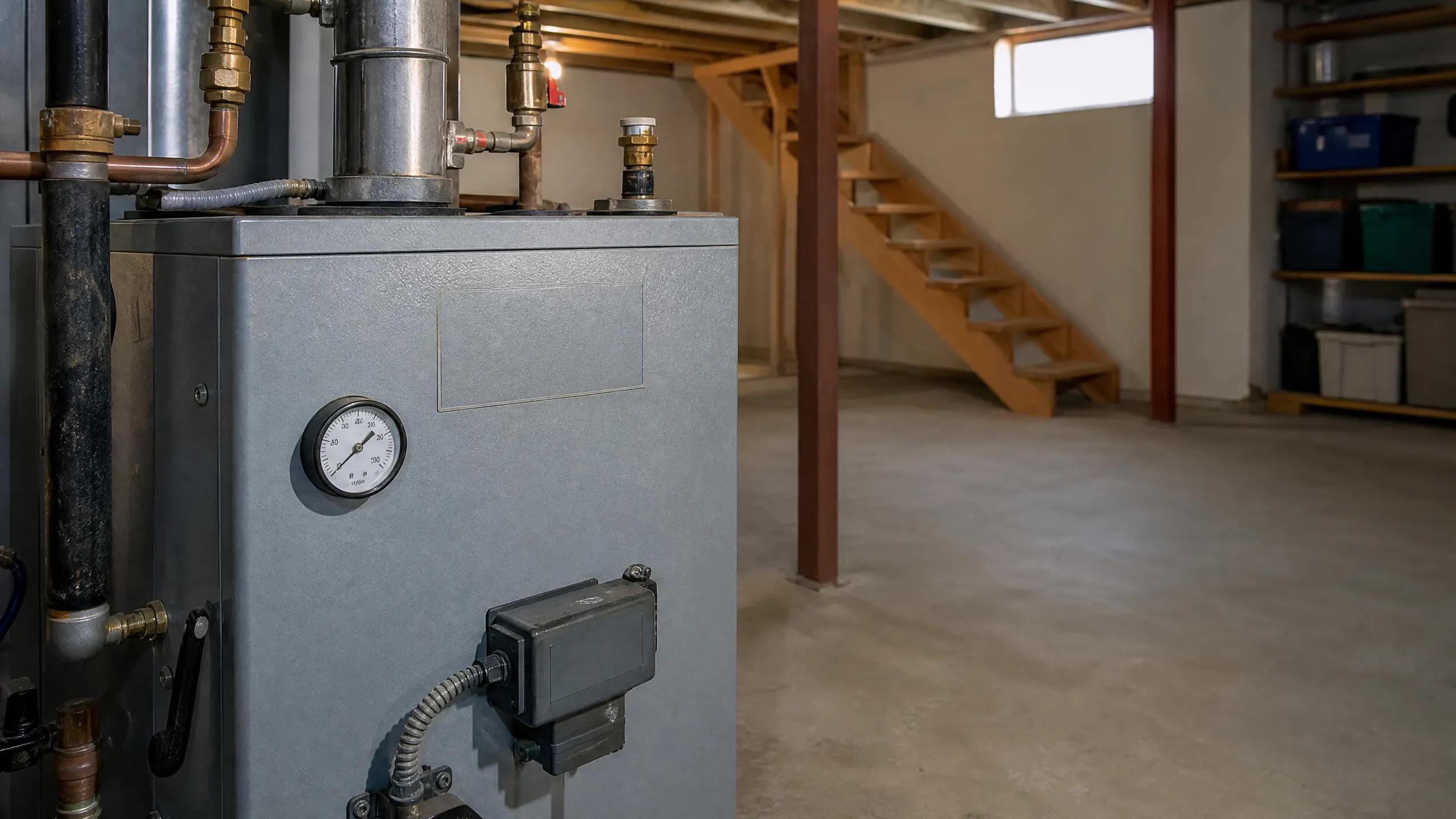
A gray boiler with copper pipes and a pressure gauge stands in an unfinished basement with wooden stairs and concrete floors.

Boiler Repair in Middletown, CT

Tell us about the job

Takes about a minute. No obligation.

RepairBoilerLower Connecticut River Valley Planning Region, CT
Step 1 of 2

What ZIP code is the job in?

The usual boiler problem shows up here too

Boilers in Middletown run from October through May, about eight months of the year. That's a long season, but nothing about it is unusual. A boiler here fails for the same reasons a boiler fails anywhere. Whatever's wrong with yours, start with a real diagnosis instead of a guess.


Cold nights mean a fix has to hold

Overnight lows average 23°F through December, January and February. A boiler that's short-cycling or won't fire right needs to get fixed correctly the first time, so it keeps running through the coldest stretch instead of quitting again in a week.

Boilers in Middletown start firing in October after sitting idle since spring.

A weak part can get through the summer fine and still fail the first cold week it has to work hard.

A boiler acting up in Middletown is probably just a boiler acting up

Heat runs October through May
Winter nights average 23°F
Half the homes here were built by 1972
Nothing about Middletown makes this harder to fix20% of Connecticut households lost power for a full day or more in 2024, and boilers need that power to fire

Half the homes in this part of the Connecticut River Valley were built in 1972 or earlier. If your boiler came with a house that old, there's a decent chance it's been in service a long time, even if it's not the original unit. An older boiler can still run fine for years with the right repairs. But past a certain point, a major repair is going into a machine that's already close to the end of its working life. Before you commit to a big fix, it's worth asking a tech how much life is actually left in it.

Ask how much life is left before you commit to the repair

Ask before you pay for the repair, not after. A tech can tell you how much life is left in the boiler, and whether this fix is worth it.

Find a contractor

Most calls come down to a few parts

A boiler that won't fire is usually an ignition problem, a failed sensor, or a circulator pump that's seized up. Low water pressure or a clogged line can stop it cold too. None of these are mysterious once a tech has eyes on the unit.

Mineral buildup wears a boiler down slowly

Scale collects inside the heat exchanger over years of use, especially if the water hasn't been treated or flushed. It shows up as banging or kettling sounds, uneven heat, or a burner that short-cycles. By the time you hear it, the buildup has usually been there a while.

Before you call anyone, there are a few things worth checking. Look at the pressure gauge on the front of the boiler. If the needle has dropped toward the low end, low pressure alone can keep it from firing, and that's something you can often correct yourself with the filling loop. Make sure the room thermostat is set above room temperature and has working batteries if it takes them. If the boiler has a digital display, look for a fault code or a flashing light and write it down, since that alone can tell a tech what's wrong before they even get there. There's usually a reset button too, but only press it once. If it trips again right away, stop and leave it alone rather than resetting it over and over, since that can mask what's actually failing.

A diagnostic visit starts before the tech touches a tool. They'll ask what the boiler was doing right before it quit, whether you heard any noise, whether the pilot or ignition sequence even attempted to start. Then they check pressure, look at the heat exchanger and burner for scale or soot, and test the sensors and pump to see which one is actually failing versus which one just looks suspicious. A lot of boiler problems share the same symptoms. No heat can mean a bad sensor, a seized pump, or air trapped in the line, and those fixes aren't close to the same job. That's why a tech traces the fault instead of swapping parts and hoping. Once they know what failed, they can tell you if it's a quick fix or the first sign of something bigger.