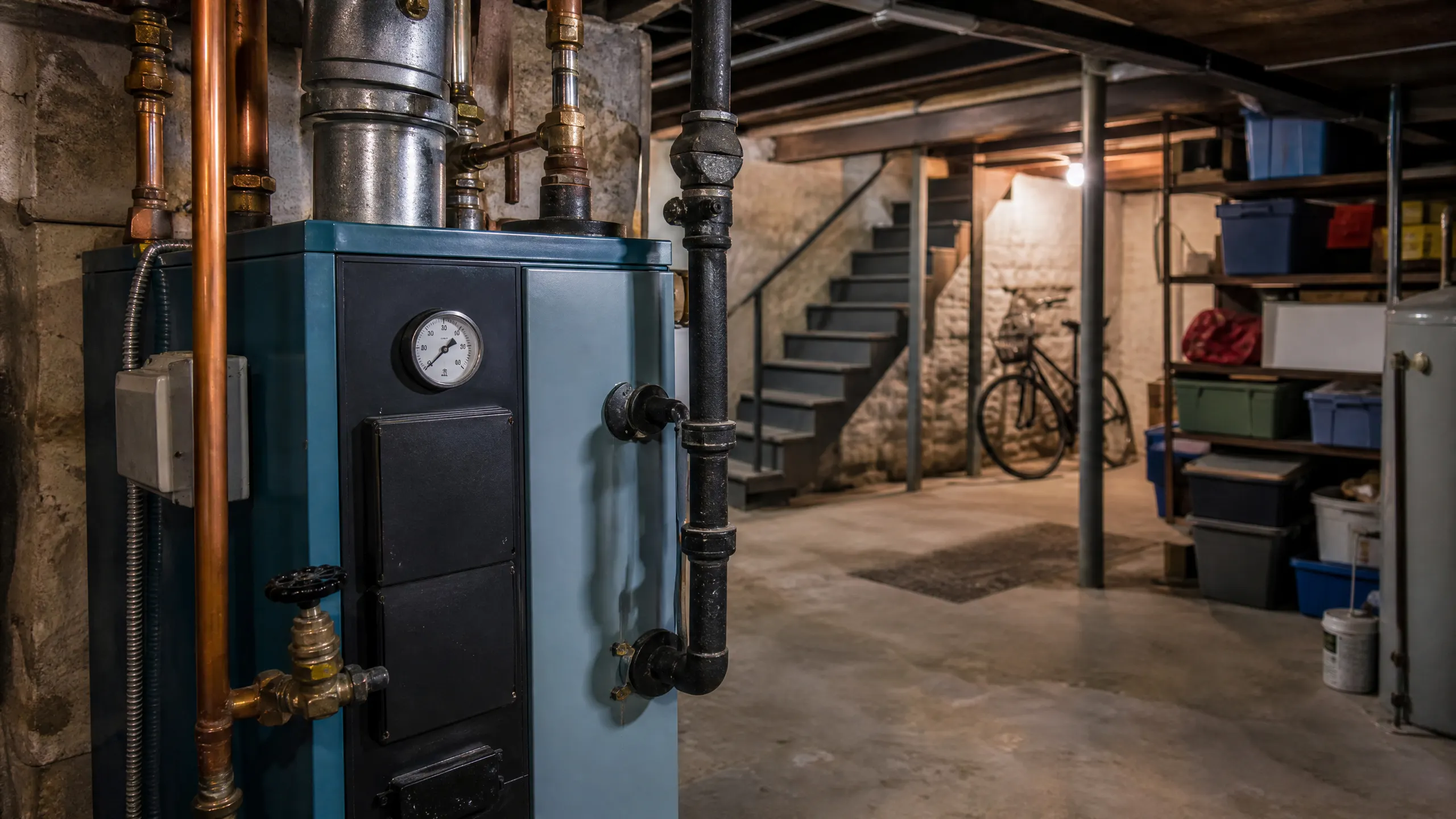




A residential basement showing a blue boiler with copper and iron pipework in the foreground, with storage shelves, a bicycle, and a staircase in the background.

Boiler Repair in Danielson, CT

Tell us about the job

Takes about a minute. No obligation.

RepairBoilerNortheastern Connecticut Planning Region, CT
Step 1 of 2

What ZIP code is the job in?

Half the homes around Danielson were built in 1973 or earlier. If your boiler came with a house that old, it may be near the end of what it can do. A circulator pump or a zone valve can often be replaced and the boiler runs another winter. But an old boiler that keeps needing attention is telling you something. Worth asking your contractor how much life is left in it before you commit to the repair.

Your boiler runs eight months a year here, October through May.

Nights near 20°F keep it firing most of the night, so a repair needs to hold up to that.

Power goes out here too, and a boiler won't restart alone

20% of homes statewide lost power a day or more in 2024
Heat runs October through May
Winter nights average 20°F

Connecticut homes running on oil paid $21.64 per million Btu in 2024. That's a cost per gallon most other fuels can't touch, and a boiler that's short cycling or losing efficiency burns through it faster than it should. A cracked heat exchanger, a dirty nozzle, bad combustion, any of these make the boiler work harder to put out the same heat. You feel that in the tank, not just the bill. Worth getting the burner and the heat exchanger checked before another cold month goes by on a boiler that isn't running clean.

September is the month to deal with it

Heat starts in October here and runs through May. Whatever's wrong with the boiler now is what fails first once it has to run all night, and that usually happens in the first weeks of the season. September is the month to get it looked at, before it's working on a cold night instead of a mild one.

Find a contractor
A man in a dark long-sleeve shirt and worn brown work pants, seen from behind, carries a canvas tool bag up the steps toward a gray front door, with a potted shrub beside the entry.

Check the pressure gauge and the water

A cold boiler should show a steady reading on the gauge, not sitting at zero or falling as you watch. If it reads low, there's a feed valve near the bottom of most boilers that brings it back up. If the pressure keeps dropping after that, water is getting out somewhere, and finding where is not a homeowner job.

Listen for what it's telling you

A boiler that bangs or knocks when it fires usually has air trapped in the lines or scale built up inside. A rumble or a kettle sound means the same kind of thing, mineral buildup making the water boil in spots before it should. Neither one fixes itself, and both get louder the longer the boiler runs that way.

A boiler that's actually failing doesn't always go quiet about it. Radiators that stay cold while the boiler runs mean heat isn't getting where it should, and that points to a stuck zone valve or a circulator pump that's given out. Short cycling, where the boiler fires, stops, and fires again within a few minutes, usually comes down to a thermostat problem or a limit switch cutting it off too soon. A pilot light that won't stay lit points to a thermocouple that's failing. Soot around the burner or a yellow flame instead of blue means combustion isn't clean, and that's not something to wait on. Any smell of gas or exhaust in the room means shutting the boiler down and getting someone out the same day.

A diagnostic visit starts before any panel comes off. A tech will ask what you've noticed. Cold radiators, banging, a pilot that won't hold, how long it's been going on. Then the gauges get checked, the pressure, the flame, the flue. Most boilers show trouble first in the same few places, the circulator pump, the zone valves, the burner assembly, and a tech works through those before going further in. If the flame looks wrong or there's soot where there shouldn't be, that gets pulled apart and looked at closely. Sometimes the problem is obvious once the cover is off. Sometimes it takes running the boiler through a full cycle to see where it actually fails. Either way, you should walk away knowing what's wrong, not just that something is.