Electricity here runs 28.75 cents per kilowatt-hour
Connecticut's electric rates are among the highest in the country. A mini split's efficiency matters more here than in a state paying far less for the same kilowatt-hour.
Takes about a minute. No obligation.
Connecticut's electric rates are among the highest in the country. A mini split's efficiency matters more here than in a state paying far less for the same kilowatt-hour.
Two mini splits can heat and cool the same room, but the one with the higher SEER2 rating uses less electricity to do it. At Connecticut's rates, that difference shows up on every bill, not just the first one.
NOAA 1991–2020 monthly normals
A mini split is a standard piece of equipment, sized for the room it's heating and cooling.
Torrington doesn't call for an oversized unit or a special model, just one with a solid SEER2 number.




Half the homes in Torrington and the rest of the Northwest Hills region were built in 1967 or earlier. A house that age wasn't built with mini splits in mind. The walls, the windows, the layout of the rooms all came before anyone thought about where an outdoor unit would sit or how far a line set would need to run. None of that rules out a mini split. It just means the installation has to work around a house that was planned for something else, not against it.
Cooling in Torrington runs from July through August. Getting a mini split installed in June means it's ready when you need it, instead of mid-job when the heat is already on.
Find a contractorSizing a mini split is not guesswork. A contractor measures the room, the windows, the ceiling height, and how the walls are insulated, then runs that through a load calculation. The goal is a unit that matches the room's real heat gain and heat loss, nothing more. Too big and the unit short cycles, meaning it blasts cold air, shuts off before it pulls the moisture out of the room, then kicks back on a few minutes later. That leaves the room feeling clammy even when the thermostat says it's cool. Too small and it runs flat out all day without ever catching up on the hottest afternoons or the coldest nights. Either mistake wears on the compressor, since it's cycling or straining more than it was built to. A unit sized right runs long, steady cycles, holds the temperature evenly, and lasts as long as it's supposed to.
A single outdoor unit can run one indoor head or several, each with its own thermostat and its own setting. More zones from one outdoor unit usually cost less to run than separate systems, but every indoor head added pulls on the same compressor. Ask what that unit is rated to support before deciding how many rooms it should cover.
Not every mini split is built to pull heat from outdoor air once temperatures drop well below freezing. Some units are rated for it, others lose capacity and lean on backup heat strips to make up the difference. If the plan is to heat through the coldest stretch of winter on the mini split alone, the rating at low temperatures matters more than the rating at mild ones.
The SEER2 number on the label is a ratio, cooling output divided by the electricity it takes to produce it. A higher number means the compressor is moving the same heat for less power, not that the room cools faster. That rating comes from one indoor head paired with one outdoor unit, running under set lab conditions. Add zones to that same outdoor unit and the installed system won't hit that same number, since the compressor is now splitting its effort across more rooms. The label tells you what the equipment is capable of. What you actually get depends on how the whole system is sized and installed, not just which box the outdoor unit came in.
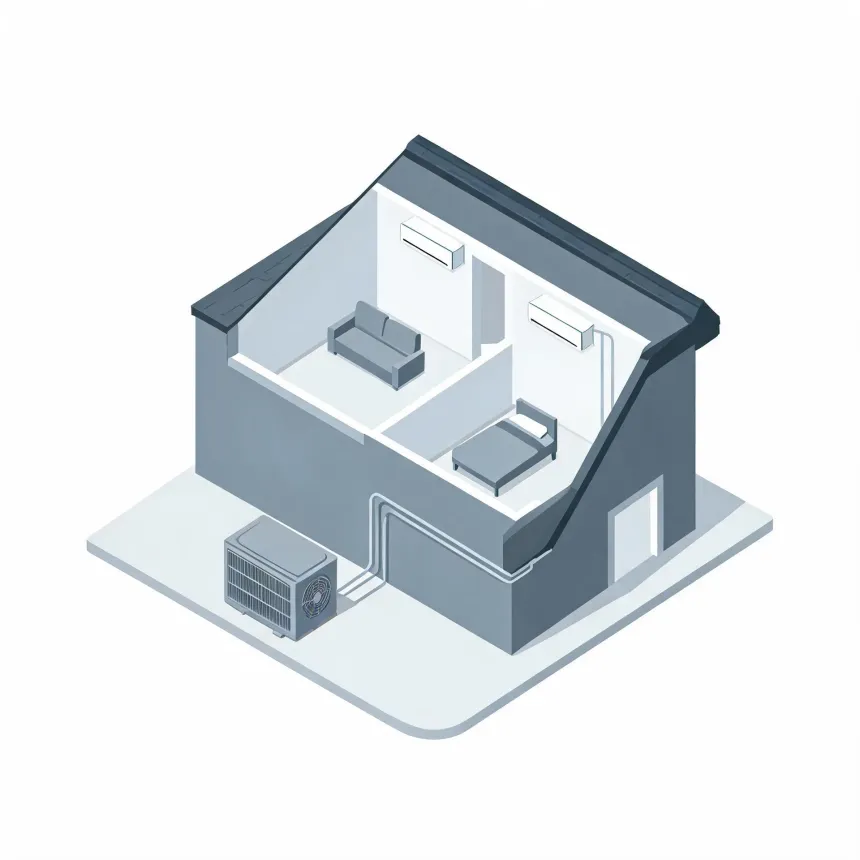
Installation starts outside, not in. The outdoor unit needs a spot with clear airflow on all sides and a path for the line set to reach each indoor head, so a contractor walks the exterior before anything gets mounted. Inside, each indoor head needs a wall stud pattern that can hold it level and a route through the wall for the line set, the drain line, and the electrical whip, usually one bored hole rather than something run through the attic. The lines get connected, then the whole system is pressure tested and vacuumed down before any refrigerant moves, because trapped air or moisture left in the lines ruins the charge. Once it holds pressure, the system gets charged, powered up, and run through each zone to check that every head is cooling and heating as it should. A straightforward single zone can wrap in a day. More indoor heads, or a run that has to cross framing or soffits to get outside, stretches that out.