




A tabby cat sleeps curled up on a dark grey bed in a modern bedroom equipped with a wall-mounted air conditioning unit.

Mini Split Installation in Hartford, CT

Tell us about the job

Takes about a minute. No obligation.

New system or replacementMini-splitCapitol Planning Region, CT
Step 1 of 2

What ZIP code is the job in?

Connecticut electricity ran 28.75 cents per kilowatthour in 2024, well above what most of the country pays. A mini split's efficiency matters more here than somewhere with cheap power, because every kilowatt it uses gets multiplied by that rate. A system sized right for the room and charged with the correct amount of refrigerant holds its efficiency rating. One that's too big for the space or low on charge won't, no matter what the spec sheet says. Over a Hartford winter and summer, that difference shows up on every bill, not just the first one.

8 months
October through May, your system heats
3 months
June through August, it cools
21°F
the average winter night it heats against
81°F
the average summer afternoon it cools against
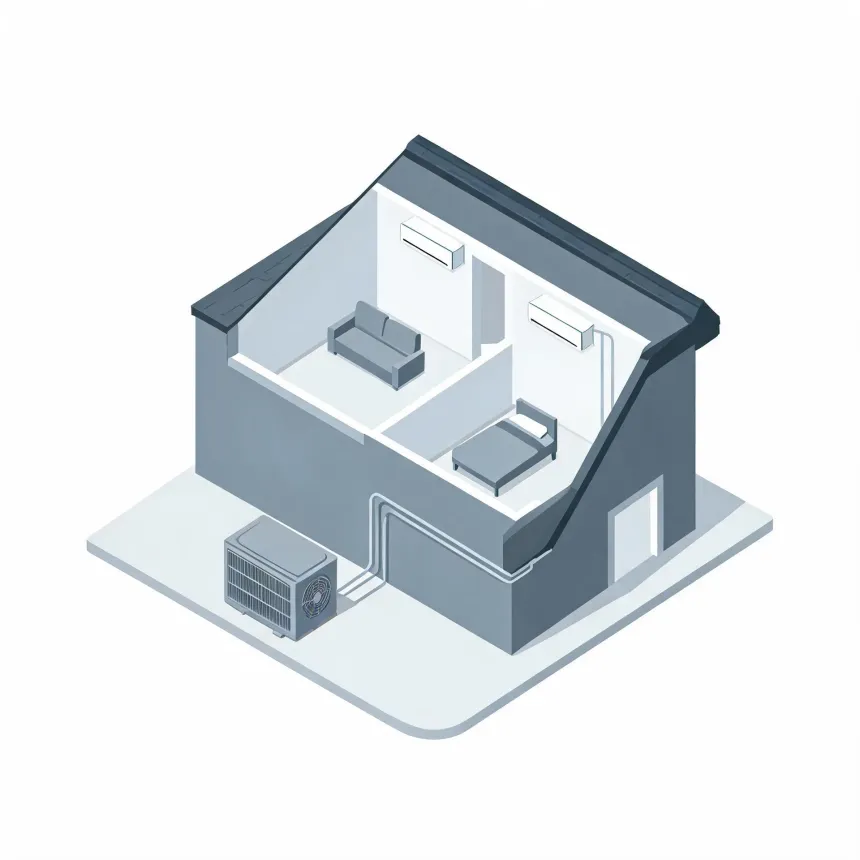
Isometric cutaway illustration of a two-room house showing two wall-mounted indoor air conditioning units connected by line sets to an outdoor condenser unit on the ground outside.
Your system heats October through May and cools June through August.

NOAA 1991–2020 monthly normals

Summer here runs June through August, about three months of the year.

A mini split in Hartford spends most of its life idle, so a dependable system matters more than squeezing out the last point of efficiency.

Half these homes were built by 1966. A mini split still has to match the one you're adding it to.

Half the homes here were built by 1966
Cooling runs June through August
Summer afternoons average 81°F

Fuel oil heats close to a third of homes in this part of Connecticut, and gas heats almost half. A mini split doesn't touch either of those systems. It runs on electricity alone, so it sits alongside your furnace rather than replacing it, usually handling a room or a zone the main system doesn't reach well. That's why most installs here are additions, not conversions. If you're adding one to a house that heats with oil or gas, the furnace keeps doing what it does, and the mini split takes on cooling, or heat in the shoulder months when running the whole furnace for one room doesn't make sense.

Get it installed before June, not during the first hot week

Cooling here runs June through August. May is the last month before that starts, and it's the better time to put in a mini split than June. Installing before the season means the system is sized, placed, and charged correctly without pressure to get a room cool that same week.

Find a contractor
A white outdoor air conditioner condenser unit mounted on metal wall brackets against gray horizontal siding, with a blue sky and white clouds behind it.

It only has three months of work ahead of it

Three months of summer, afternoons around 81. That's the load a mini split in Hartford actually sees. It won't run hard enough, long enough, to make a few extra efficiency points worth paying for. Put the money into a unit that's sized right and installed correctly instead of chasing the top spec sheet. A mid-range system that's properly matched to the room will outlast a top-tier one that's oversized or undercharged.

The line set and the wall decide the cost

Where the indoor head goes and where the outdoor unit can sit drive a lot of the job. A short, straight run between them is the easy case. If the line set has to go through an attic, drop down an exterior wall, or run further than a standard length allows, that's more material and more labor, and it can call for a larger line set or additional refrigerant. The condensing pad location matters too. A tech has to find a path that works with the framing instead of fighting it.

The electrical work is often separate from the unit itself

A mini split needs its own dedicated circuit, and whether that circuit already exists or has to be run from the panel changes the scope of the job. An older panel with no open slots may need a subpanel or a different kind of breaker work before the mini split goes in at all. None of that shows up in the price of the equipment. It's part of what makes one installation simple and another one not.

The efficiency rating on a mini split's label tells you how much heat it moves per unit of electricity it uses, measured under set test conditions. It's useful for comparing one system against another, but it's a lab number, not a promise. Run the same unit in a room it's too big for, cycling on and off instead of holding a steady, low output, and it won't hit that number. Starve it of refrigerant or crimp the line set, and it won't hit that number either. The rating describes what the equipment is capable of, not what it will do in your house. A correctly sized, correctly charged mid-range system will often beat a top-rated one that was installed wrong, because the installation is what decides whether the rating on the box ever shows up on the wall.

Installation starts with the walkthrough, not the drilling. A tech looks at where the indoor head will hang, where the outdoor unit will sit, and what's between them, since that path decides most of what happens next. Once the spots are set, a hole gets drilled through the wall for the line set, the refrigerant lines, power wire, and condensate drain bundled together and run through it. The outdoor unit gets mounted on a pad or bracket, the indoor head gets hung on its plate, and the lines get connected at both ends. Before anything turns on, the line set gets vacuumed down to pull out moisture and air, because trapped moisture in the lines causes problems later that are a lot harder to fix than they are to prevent now. Only after that does the system get charged with refrigerant and tested, running it long enough to check that it's holding temperature and cycling the way it should before the tech leaves.