Electricity here runs 28.75 cents per kilowatt-hour
Connecticut's electric rates are among the highest in the country. A mini split's efficiency matters more on a bill here than it would somewhere paying less per kilowatt-hour.

Takes about a minute. No obligation.
Connecticut's electric rates are among the highest in the country. A mini split's efficiency matters more on a bill here than it would somewhere paying less per kilowatt-hour.
When you're pricing out units, look at the efficiency rating before the price tag. A system that uses less electricity to move the same heat costs less to run every month it's working.
NOAA 1991–2020 monthly normals
A standard-size mini split handles a typical Danielson home.
Nothing about this area calls for sizing up beyond what the room needs.




Efficiency is a spec you can compare before anyone touches a wall. Every mini split carries a SEER2 and HSPF2 rating, and that number is what decides the electric bill, not the brand or the color of the unit. At 28.75 cents a kilowatt-hour, the gap between a mid-efficiency unit and a high-efficiency one shows up every month, all year, since this system both heats and cools. Ask for that rating on the quote itself, not just the price. Two bids for the same size unit can carry different ratings, and the lower price up front doesn't always mean the lower cost to run.
Most homes in this area heat with fuel oil, not electricity or gas. A mini split adds electric heat and cooling without touching the oil system, so it works alongside what's already there instead of replacing it.
Find a contractorAn old zoning job or a patched duct run doesn't carry over to a mini split. The line set goes in new, sized for this install, and the indoor units get placed to match how the rooms are actually laid out now. If a wall is load-bearing or a chase doesn't line up where you'd want it, that gets worked out before anything's mounted, not after.
A contractor works out the load for each room from its square footage, how many exterior walls it has, how many windows, and what's above and below it. An attic room and a room over a basement lose and gain heat differently even if they're the same size. Each indoor head gets matched to its room, not to the house as a whole.
A unit too big for the room blasts cold air until the thermostat's satisfied, then shuts off. That cools the air fast but doesn't run long enough to pull humidity out, so the room ends up cold and damp. The right size runs longer at lower output and leaves the air feeling right, not just cold.
If the old system is ducted, that ductwork usually stays right where it is. A mini split doesn't tie into it, so nobody's ripping out vents or patching ceilings to pull it. If the old equipment is a window unit or baseboard electric, a contractor disconnects and removes it as part of the job. Either way, the mini split goes in as its own system, wired on its own circuit, and the old equipment's removal doesn't hold up the install or depend on it.
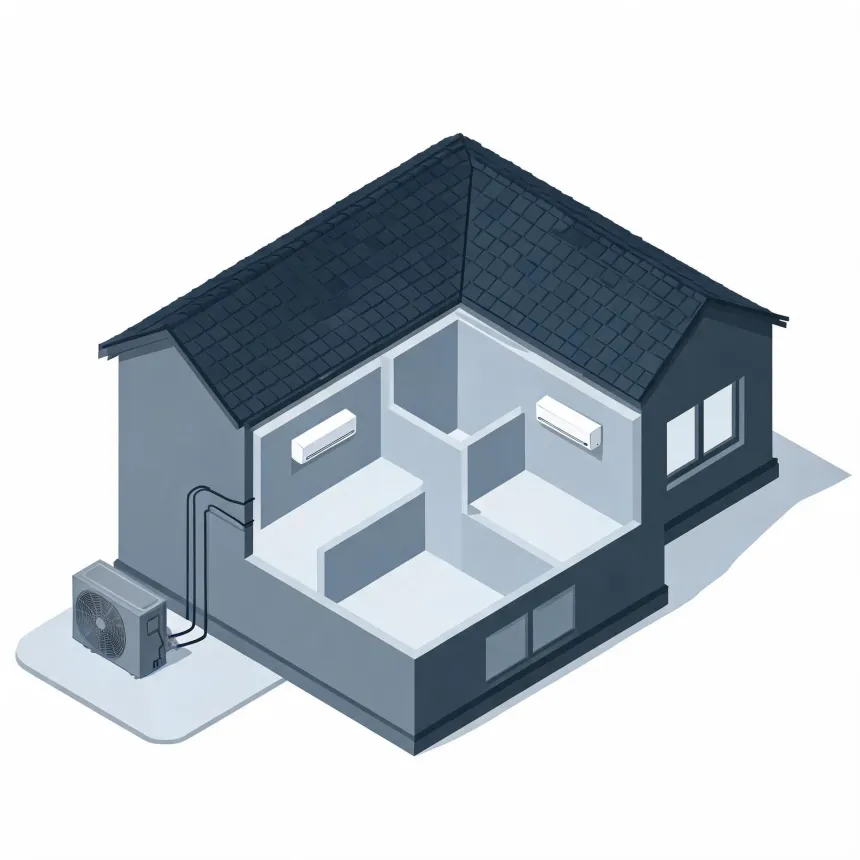
Install day starts with the outdoor unit. It gets mounted on brackets against an exterior wall or set on a pad, somewhere with clear airflow on all sides and room to service it later. From there, a contractor runs the line set through a hole drilled in the wall, usually the shortest straight path to the indoor head. That line set carries refrigerant lines, a condensate drain, and electrical wiring together, wrapped and sealed where it passes through the wall. Once the indoor unit is mounted and everything's connected, the system gets evacuated with a vacuum pump to pull out air and moisture before refrigerant ever flows through it. That step matters more than people expect. Any moisture left in the lines mixes with refrigerant and causes problems down the road that are harder to fix than they are to prevent. After that, it's a pressure test, then power on, and the contractor checks that each head is actually heating and cooling before calling the job done.